mardi 23 septembre 2014

SHANAH TOVAH TIKKATEVU 5775 WELCOME JEWISH NEW YEAR

SHANAH TOVAH TIKKATEVU
WELCOME TO THE JEWISH NEW YEAR 5775
This New Year, as I dip the apple slices into the honey, I would remember fondly the various conversations around the Jewish New Year around the world.
Sarah Cohen from Jew Town in Cochin gave me a little honey (pure honey, she said) to take home to celebrate and welcome the Jewish New Year. Wish her and others in Cochin a Happy New Year!
(Sarah Cohen reciting morning prayers. Cochin, India)
Adela Dworin and her congregation in La Habana, hope the emerging liberal attitudes help people express their Jewishness without fear. In Cuba, while the government has a strong pro-Arab policy, an average Cuban is Pro-Israeli (a small state standing up against multitudes of Arabs, reminding them of their own struggle with USA). There is no indigenous Muslim population in Cuba and the majority of Muslims are students from various countries as well as members of Diplomatic corps.
(a cuban jewish jazz shabbat!)
It is not in these isolated communities one feels the fear these days, but in larger Jewish communities such as in France and Belgium. And the prospect of returning fighters from Syria and Iraq is gloomy one indeed.
But there are many other things to be grateful for. Benyamin Netanyahu announced recently that the Jewish population of Israel has reached 6 million, a number very significant to us, because of the number lost during the Nazi Holocaust.
October is also the month of Nobel Prize announcement, something many of us look forward to. In recent years, Israel had garnered 8 Nobel Prizes in SCIENCES, no small achievement for such a small but determined country.

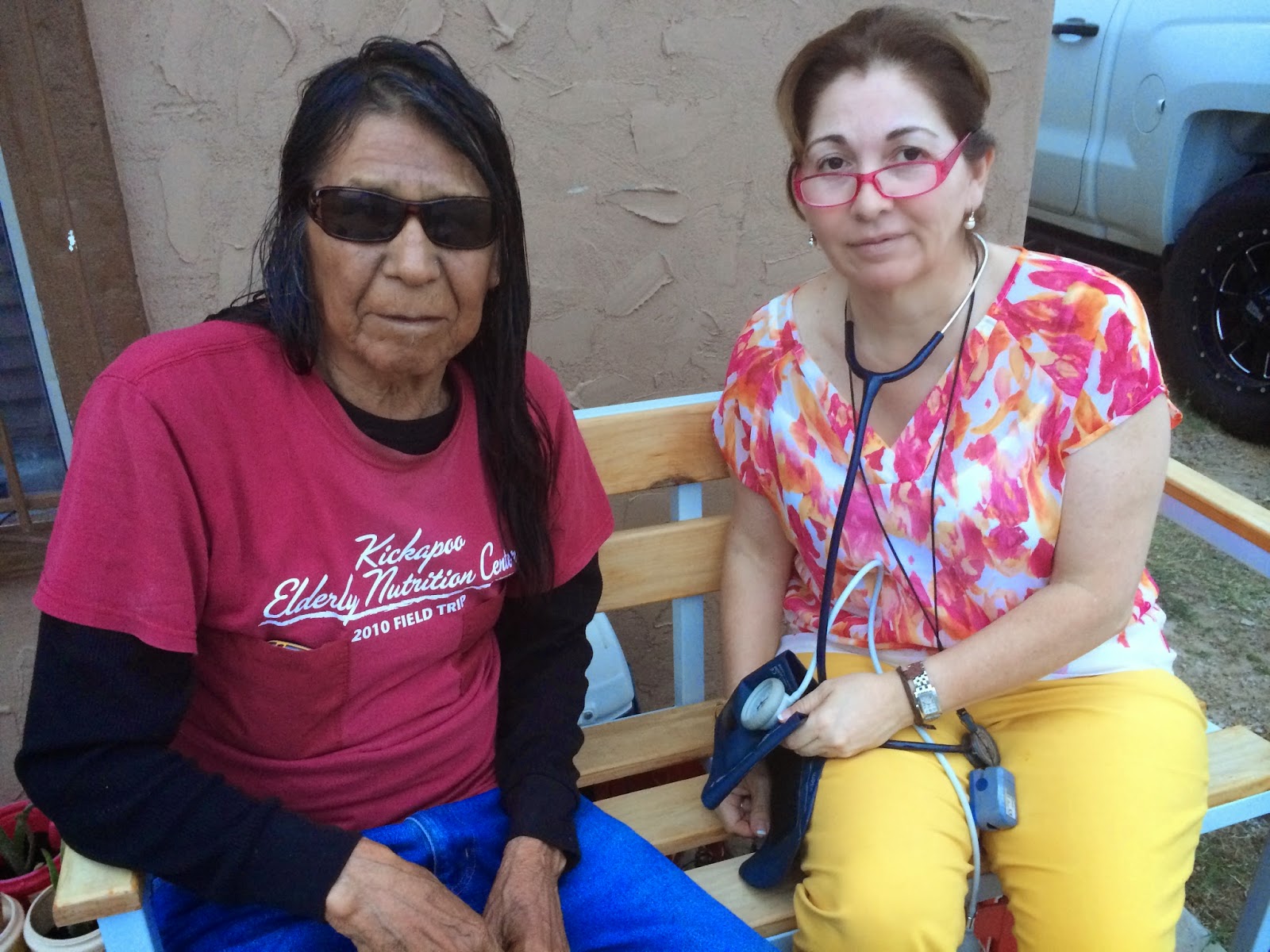
Each of us carries with us, the pleasure of being a Jew, but I couldn't stop chuckling when my UmonHon Indian sister wrote:
I guess I always think of you as being UmonHon and not Jewish!
By the way, American Indians bear no grudge against the Jews since historically we are not associated in their memory with destruction of their culture! They also respect the fact that we don't wish to impose our culture upon outsiders.
During this wonderful time of the year, leading up to the Day of Atonement (I am looking forward to spending that with good friends in Miami), it is nice to think of the wide net of affections spanning this world:

Australia, Cuba, USA, Mexico, Iran, Indonesia. And of course Israel.


lundi 22 septembre 2014

SAFE JOURNEY, DEAR FRIEND AND SPIRITUAL LEADER CHA KO KA


Elisa Herández  from the Newspaper Vanguardia
MÚZQUIZ.- Le atribuían el don de la adivinación, y Chakoka Anico Manta, jefe espiritual de la tribu Kikapú, falleció la madrugada de ayer, 16 de Septiembre, después de que en varias ocasiones previó que moriría un día especial de 2014.
Chakoka, de 83 años de edad, murió debido a problemas renales y coronarios que padecía, y de los que había sido atendido en una clínica de Austin, Texas, pero por sus costumbres y creencias, no permitió que se le amputaran varios dedos del pie. 
Patricia Carrillo, coordinadora de Actividades Cinematográficas de la Secretaría de Cultura del estado y amiga de Chakoka, el jefe de los kikapú mencionó en repetidas ocasiones que su muerte sucedería este año y en “un día especial”. 
La mañana de ayer la tribu kikapú celebró una ceremonia fúnebre para posteriormente realizar un ritual de velación al que estuvieron invitados amigos cercanos al jefe.
Es la primera vez en la historia de esta comunidad que el funeral de un guía espiritual permite la presencia de personas externas a la tribu.
Chakoka Anico fue un hombre sumamente inteligente, alegre, sabio y con un excelente sentido del humor. 
Será recordado por haber logrado el reconocimiento de la tribu kikapú entre el gobierno y la misma sociedad, especialmente el respeto por la tradición de la cacería del venado que durante décadas les acarreó conflictos con las autoridades.
“Hoy estamos muy consternados por la muerte del amigo Chakoka Anico, una gran persona, un gran amigo, un gran líder que siempre quería que su etnia estuviera en mejores condiciones” dijo Alfredo Jiménez, amigo del fallecido y líder de los ganaderos de Múzquiz.
“La muerte de Chakoka fue a las 3:51 de la mañana, a mí Oresmo (uno de sus 10 hijos) me avisó alrededor de las 5 de la mañana para que yo lo hiciera público”. 
El gobernador Rubén Moreira lamentó el deceso de Anico Manta a quien dijo que podría hacérsele un homenaje, si lo permite la tribu. 
“Su deceso entristece a Coahuila”, dijo, “Él no era solamente el líder espiritual de la tribu, sino también un símbolo de la riqueza étnica de nuestro estado”.
Defensores de Coahuila
Staff
Habitantes de “El Nacimiento”, municipio de Múzquiz, los Kikapú son, junto con los Mascogos, desde la Colonia, los únicos grupos indígenas en Coahuila, estado al que defendieron de otras tribus.
Los kikapú son una tribu que habita tanto en México como en Estados Unidos, donde ocupan reservaciones en Oklahoma, Kansas y Texas.
Desde hace 14 años Chakoka Anico representaba a los 5 mil kikapú de ambos países. En El Nacimiento viven mil personas en ciertas épocas.
En el siglo 18, el rey Carlos III de España, les cedió terrenos en Coahuila. Tras la Independencia, Guadalupe Victoria los dotó de tierras en Texas.
En 1852, el presidente José Joaquín Herrera los ubicó en Múzquiz, con el compromiso de combatir a los apaches y comanches en la región.
Benito Juárez ratificó la autorización, y en 1919 Venustiano Carranza les regaló 7 mil hectáreas.

From Zocalo
LA TRIBU

La tribu kikapú a la fecha suma 5 mil integrantes. Dispersos entre Coahuila e Eagle Pass, los kikapú procuran interactuar con mexicanos y americanos. Con todo y los avances tecnológicos, la transculturización y la globalización, mantienen sus costumbres.

Si bien el pueblo depende de la ayuda de los gobiernos estatal y federal para infraestructura, en cuestiones como carreteras, drenaje o electrificación, el pueblo siempre ha decidido sobre su formación escolar, espiritual, cultural y sus leyes.

El Nacimiento es el lugar en el que la tribu se reúne para llevar a cabo las prácticas de su religión. En su territorio sagrado son protegidos por ellos mismos y por los habitantes de Múzquiz, que los cobijan como un tesoro ancestral.

“Todos conocen a los kikapú, saben que aquí vivimos, que aquí estamos y que también nos vamos; saben que somos una tribu, pero no todos conocen nuestras ceremonias, si no es kikapú no puede saber más”, asevera Chakoka.

De los 5 mil indios con vida nómada, el 60% son mujeres y el 40% varones. Sin importar su género, el jefe de la tribu asegura que no han sido víctimas de la discriminación
THANKS FOR EVERYTHING YOU DID FOR US..WE WILL REMEMBER YOU

dimanche 21 septembre 2014

CUBA LENDS A HAND TO DISPLACED PEOPLE OF SAHARA

Wherever there is oppression, CUBA lends a hand..
And some of the results can be beautiful MUSIC.. that carry that message

Africa Beats: Aziza Brahim voices Western Sahara blues
21 September 2014 Last updated at 00:01 BST
Aziza Brahim was born in the disputed territory of Western Sahara, most of which is currently under Moroccan control, and grew up in refugee camps in south-west Algeria.
Now she is using her beautiful and compelling voice to draw the world's attention to the ongoing plight of her people.
"I think music is the most powerful weapon," she tells Africa Beats. "If I can give publicity to my conflict, it's a duty and a satisfaction."
She comes from an artistic family - her grandmother is Al Khadra, a legendary Saharawi war poetess. Aziza Brahim left the camps to study music in Cuba and now pursues her musical career in Barcelona.
Her fourth album Soutak (your voice) was released earlier this year to high acclaim.


Realizamos desde aquí nuestro particular homenaje a los Hijos de las Nubes, que lucharon contra la invasión del enemigo, a través de las imágenes del documental "Goulili Dios Moi Ma Seour", producido por Inger Servolin para Iskra Films en 1991. 
Quizás uno de los mejores documentales realizados sobre la Mujer Saharaui y el conflicto de su país.

Cubans in the island in general are aware of the struggles of the Saharawi people. Many of the university students have or have had classmates of Saharan Origin. At the  Latin American School of Medicine, there are quite a few students from Saharawi studying to be doctors. Cuba has conducted Humanitarian Medical Missions to this particular region, as part of their global strategy of helping poor people with health and sanitation and vaccination and maternal child health.
The man conducting the Tea ceremony is studying Medicine at ELAM medical School in Havana, Cuba

OBSESSION WITH SUFFERING, ILLNESS AND DISEASE

OBSESSION WITH SUFFERING, ILLNESS AND DISEASE
I begin my lectures on Medical Anthropology, discussing how the common metaphors in the society had changed from Religious to Medical. Benjamin Franklin suffered from Gout, because of a Sinful Life, now it would be referred as an Unhealthy Life Style. Metaphors about Cancer abound, and in combinations with military metaphors, dominate the daily headlines.
I have noticed that people take a certain delight to inform you (Is it because I am a Physician?) of the latest catastrophes to fall upon the individuals in their social circles.
Is it a superstition to avoid the same fate falling upon them?
Within a matter of days, I was told of someone suffering from stage 4 Colon Cancer, another with Prostate Cancer, a middle aged man suffering seizures and slipping into a coma, a death from breast cancer, someone’s toe being cut off because of gas gangrene.
I am very optimistic by nature and would like to hold the world not as a dangerous place but a pleasant place to live in. There are certain risks to be taken in achieving this pleasantry and that, one does in ones own stride.
I would like people to be healthy, would advise how to maintain health.
I wanted to know the origins of this obsession with disease rather than Health and was reminded of the little anthropological study I did with myself as the patient.
I approached various specialists in different countries and presented myself with a desire to know more about prevention of disease. But the doctors kept on asking me; do you suffer from any symptoms? No, I said with glee. All of them, American or European or Asian were baffled. They can give me advice only when there is disease but not how to prevent that very same disease.
When the metaphor is about Disease rather than Health, the discourse also turns to Disease rather than Health.
The scare mongering media with its outlook of sensationalism adds fuel to this fear of ill health and harm.
Mary Douglas, a British Anthropologist, devoted her professional life to studying Risk and Danger.
Working with American Indians one good lesson to learn is that Life is chaotic and an order cannot be bought or readily accessible and that one has to accept it. Uncertainty is part of life and one has to adjust to that. That lesson has been very helpful to this wandering Jew!
So I was very happy to hear from my good friend, the humble man of Bogor, who is very interested in Prevention of Diseases among all his employees!

This morning, he had arrived at the lakeside near his house where a few faithful had gathered and they spent the next one-hour jogging and walking and talking. A bicycle ride completed the morning exercises followed by coffee and breakfast in the office for all those present.
I had left a BP/Pulse recording machine with him and occasionally he would send a reading on himself or someone he is concerned about.
My friend the humble man of Bogor who is now 53 years old had the following BP Pulse reading this morning:

BP   105/65 mm Hg
Pulse 52 beats per minute.
He is on no medications.

Thank you, dear friend, for positive news in this world full of so much negative news! Positive in that, emphasizes what is normal, negative emphasizes what is abnormal

featured posts

FERDOWSI, THE SHAHNAMEH, AND THE IRAN OF MY HEART

FERDOWSI, THE SHAHNAMEH, AND THE IRAN OF MY HEART Reflections on a journey through the Everglades The road to the Indigenous communi...