mardi 31 mai 2011

GRATEFUL LIST ON THIS BEAUTIFUL SPRING DAY AMONG THE AMERICAN INDIANS


It has been a long time since I have had such a sense of balance in my heart and in my life.
As my Hocank Sister would say, “without sacrifice, you cannot hope for harmony in life”. Without that harmony, peace of mind is not attainable, without that peace of mind, loving one another and experiencing affection becomes difficult.
I will summarize How to achieve this Balance. Without elaborating but just mentioning the places from where the people contributed to this Balance.
1. Gratefulness (Paris, France, Sister Jackie in Miami)
2. Asking for Forgiveness (Portland, Oregon)
3. Tolerance of the Old &
Acceptance of the New (Yoga with MunChing in Kuala Lumpur)
4. Giving of yourself without Expectations
(The American Indians)
5. Gift of Time
Spend time with Friends (Since April 1st, I have traveled to be with friends in:
Vancouver, Bellingham, Seattle, Portland, Eagle Pass, Muzquiz, Kuala Lumpur, Yangon, Cambodia, London, Miami). And always the American Indians(many many in different tribes: Hocank, UmonHon and Kickapoo, Meskwakia among others)
6. Accepting your position in this Universe
(Spirituality)
7. Learning not to judge people. (taught by American Indians but reinforced by M/Paris and R/PDX and MC/KL)
8. Respect others and If possible Love them.
(Told by Meskwakia Indians)
I have never felt so loved as I am now: all of those mentioned above plus my dearest friends in Cuba.
Once again thanks to my teachers (my friends and relatives among the North American Indians), thanks to my friends and lovers and my family.

I have just spent a few days with my sister Jackie in Miami and her husband Joseph. The unselfishness of M in France always touches my heart. I cannot have a better friend than MC in KL.

So, on this morning I am grateful that all of you are in my life. Introduction to Raja Yoga has given a better understanding of others and as Indians would say, just walk around people who are walking another path

dimanche 29 mai 2011

LINGUISTIC DIVERSITY OF AMERICA-NEW YORK


As Medical Students, we had a lunch time talk by a visitor (appropriately dark skinned), about Cross Cultural Sensitivity and we were told that we had to be sensitive about African People and a few words about East Asian Indians. So we learned about Reggae, Calypso and Curry. It was so superficial that it was pathetic. There was no mention of Cross Cultural sensitivity the rest of the time.
Move the clock around to New York 2011
176 languages are spoken in its Public School System. (how many of you can name 176 languages, I think all of us can name about fifty quite easily). But the interesting fact is that some of the Endangered languages have found their refuge in New York City. You may hear, in New York City:
Vlashki, from the mountains of Croatia
Mumuju from the island of Sulawesi
Aramaic, Chaldic and Mandaic
Bukhari from Uzbekistan where fewer people than in New York speak Bukhari!
Chomorro, familiar to the people who have visited Guam or read Oliver Sacks
Irish Gaelic is dying in Eire, but not so in New York, Kashubian from Poland is spoken here.
Upto 300 or 400 000 people whose mother tongue is one of the indigenous languages of Mexico live legally and illegally in the confines of the city.
Rhaeto-Romanic, Romany and Yiddish can all be heard in this city.
In fact, when we see a "latin face", an Indianness etched into the face, we think of Mexico and other parts of Indigenous America. and we assume they speak Spanish. But they may be one of the 400000 Indians from outside the borders who may not speak Spanish or English, but fluent in their Mixtec, Nahuatl, Chinantec, Otomi, Quechua. In California it is estimated that 150 000 people speak Mixteco! Up to 200 000 Garifuna speakers live in New York City.
In Staten Island, you can hear Chiananteco. South Bronx and Astoria, Queens claim Otomi. In fact National Geographic magazine had an article about a street in Astoria in which the most number of languages are spoken! A community speaking Trique lives in Albany. In Trenton, NJ one can hear Quiche, Paterson, NJ are home to soem Quechua speakers so is Queens, NY.

What about the old fashioned thoughts about "foreign Languages", we thought about French, Spanish and German. Now there are here by the thousands. Russian neighbourhoods and Punjabi, Marathi, Bangla food and language is no stranger to this island cheated from the native Indians a few centuries ago.. Japanese, no worries; Chinese, by the hordes.. Tamoul? Malay? Thai? Burmese?
In fact it is estimated that there may be 800 different languages spoken in New York City!
Perhaps the New World would offer some of these dying languages, a small chance of revival and hope for future speakers...


http://www.dailymail.co.uk/sciencetech/article-1151045/Cornish-Manx-Irish-2-500-languages-facing-extinction-says-UN.html

samedi 28 mai 2011

LIFE STYLE CHANGE FOR TYPE 2 DIABETES


What is lifestyle Change for a patient with Diabetes?
A patient with Type 2 Diabetes is usually given a lot of information but rarely given tools to understand why they have to change. We have been given education, an Indian patient told me, but we never received it.
You can use your discretion and cheat, someone may advise but that is not a good advice. Avoid all that is bad for you.. If you dont understand your body, how can you succeed in your everyday life?

Today at a pool party at the house of an affluent young family (the husband was celebrating his 38th birthday), I saw a friend of mine using his concept of understanding his body and I could see why his Diabetes is under so well a control.
This photograph shows some of the food that was available at the party. Even not taking into consideration the cake and the desserts, the party was catered at around 30 dollars per person.
Every one was having the time of their lives, all sorts of drinks, lots and lots of food and thumping Caribbean music.
What was our friend, we will call him Papa J, doing?
Succumbing to the temptation of succulent food available? Imbibing on the various liquors?

Let me share with you his Laboratory tests from this last week

HgbA1c a measure of Diabetes Control 5.9 %
Total Cholesterol 106 mg/dl (2.74 mmol/l)
Triglycerides 144 mg/dl (1.62)
These values are absolutely normal and in a patient with diabetes indicate EXCELLENT control of the metabolic dysfunction.
He was practicing without him being conscious of it, his adherence to his knowledge of his body and weaning himself of the riches of the society which gave him Diabetes in the first place.
Attachment usually follows pleasure, the more an object/person gives us pleasure, the more desire for it. The sensation from the pleasure will sink into our subconscious mind as memory and craving. The more one has the I-sense (identification of oneself with external objects), the more pleasure he will seek or the more he will be attached to the external world.
Papa J has detached himself from the pleasures that he has made his body not crave, despite it being available, because he knows that it is that attachment that makes for a bad dysfunction of his body. No excuses were made, oh, this is a birthday, and I will have just a glass wine and a piece of cake and a piece of barbecued rib.
I watched him, keeping a good distance from all that was offered. Nor was he feeling isolated while the rest of us were digging into taste that would make us more addicted to the food that causes our metabolic dysfunction even worse.

Weakening of these bonds to the external world is the liberating experience. In case of Papa J, his Diabetes is better controlled than 99 per cent of the Americans, not to mention a Cholesterol level in an enviable range! (He is not on any ant cholesterol medications)

Understanding your own body is necessary for the welfare of your body. Papa J was not following any dietitian's advice but he knew he has to do this for the good of his body and the laboratory tests show and his own doctor cannot believe how well they are. Neither he nor the medications are given undue credit, the credit goes to Papa J and his Rejection of Ignorance about is own body
Papa J is an inspiration for all of us, including those people who have Diabetes.

vendredi 27 mai 2011

Where are People More Equal and Healthier


when talking about standards of living, GDP, Gross Domestic Product is often mentioned and most travelers realize that it is not a good indicator of the quality of life. Most educated people in this world know that Quality of Life measures much more than your income, even though it does count a lot. Availability of Leisure activities including Arts, Literature and Music count towards good living. Consumption in the form of Material and non material goods is taken into account. Personal Health is important to most people wherever they live. and all educated people would opt to live in a more equal society such as France,or in one with at least with some semblance of it, such as USA..


Beyond GDP? Welfare across Countries and Time

Charles I. Jones, Peter J. Klenow

NBER Working Paper No. 16352
Issued in September 2010
NBER Program(s): EFG

We propose a simple summary statistic for a nation’s flow of welfare, measured as a consumption equivalent, and compute its level and growth rate for a broad set of countries. This welfare metric combines data on consumption, leisure, inequality, andmortality. Although it is highly correlatedwith per capita GDP, deviations are often economically significant: Western Europe looks considerably closer to U.S. living standards, emerging Asia has not caught up as much, and many African and Latin American countries appear farther behind. Each of the four components we introduce plays an important role in accounting for these differences.


when thinking of Egalitarian societies, we dont think of Asia (with the exception of Japan) or Russia first, always think of USA or Europe. In fact there is a fairly good correlation between Egalitarianism and General Welfare and income of the countries: Australia, Sweden, Norway are on the top, while most Asian countries lag far behind. Even countries which have higher GDP such as Singapour, Brunei in Asia and the Gulf countries in the Middle East, fail to make the chart when it comes to a Good Quality of Life ..

In view of the current debate of Gross national Happiness, these revelations are of interest

mercredi 25 mai 2011

EAT HEALTHY SAVE THE PLANET RESPECT JAPANESE CULTURE


EAT HEALTHY SAVE THE TUNA SPARE THE GROUPER HAVE A KIND HEALTHY HEART AND SAVE THE PLANET

Among the ubiquitous proliferations, insulting to a Japanese sensibility to cuisine, has been the Restaurant Japonais, selling Sushi and Sashimi. These are usually run by cunning Chinese and Koreans who saw the decline of the Chinese Food among the Western Populations. In the USA at least, they don't call each and every Sushi joint, Restaurant Japonais but call it what it is, an American version of the Japanese food, Sushi, which in turn might have its origin in Inland China!
A few years ago, an intense interest rose among the Nutrition Science Community and the General Public when it was found that the Inuit who subsist on whale blubber and sea fish and no vegetables of note have some of the lowest rates of heart disease in the world. Before long Omega 3 fatty acids took the centre stage and now you can buy them at any convenience store in America.
The simultaneous rise in popularity of Sushi joints may not have been a coincidence, as Americans, proud of their Meat diet (however contaminated it is with Growth Hormone, Antibiotics and other injected substances) found a way to include Fish in their diet in the form of Sushi.
All the while the Japanese were clobbering whales to death in large numbers and the Chinese and Koreans along with the Japanese were denuding the seas of fish like Tuna. Not just the Asians, the feeding grounds for once numerous Nassau Grouper was being overfished by fishermen based in the Bahamas and Belize
Conservation of the Nassau grouper a keystone species

Nassau Grouper (Ephinephelus striatus)
The Nassau Grouper is commercially extinct throughout much of its range. It has been red listed as an endangered species by the World Conservation Union, and is a protected species in US federal waters. In the Virgin Islands,Nassau grouper were reported in 1900 to be “..a common and very important food-fish, reaching a weight of 50 pounds or more.” The fish is now commercially extinct in those same areas. The Bahamas and Belize have the last significant stocks of Nassau grouper in the world; it is up to us to ensure that we continue to have these fish for our future.
Groupers are very slow growing fish, and some species of grouper live to be over 120 years old. They are an important component of healthy marine ecosystems. Groupers have the unfortunate habit of ‘grouping’ together in the thousands to reproduce. These groups are called spawning aggregations. Nassau groupers form “spawning aggregations” at predictable places during the full moons in the winter months.
Fishermen have long known about these aggregations and have targeted them- in the past with sailboats and hand lines, but now with traps, spears, big nets and satellite navigation equipment, many more fish can be caught. Many of the fish caught at aggregations have not yet had the chance to release their eggs. Some Bahamian aggregations that once had tens of thousands of fish now only have a few hundred, or have disappeared completely. The primary factor responsible for this drastic decline has been uncontrolled fishing when the fish are spawning. Failure to protect Nassaugrouper spawning aggregations in Bermuda resulted in a 95% decline in the population, and commercial extinction of local stocks. Many aggregations have been lost entirely, and there is strong evidence that once an aggregation has been fished out, it will not return.


American sushi is LARGER in general. The individual pieces are usually too big to eat in one bite, and the sushi rice is a little sweeter. In the same way that other cuisines are altered in the United States, more emphasis is put on the quantity of sushi and less on quality and eye appeal. The world-famous American sweet tooth is catered to with a sweeter rice dressing and meal proportions have expanded to rival meals available at other restaurants. The traditional Japanese reverence for good quality food in small portions has dissipated in America, with sushi bars deferring to the American-sized appetite and attraction to colorful food in big portions. The difference is unperceivable to the untrained diner, but an American and a Japanese sushi bar are two very different things.

Don't expect to find much of the following in an American Sushi joint..


Seafood
All seafoods in this list are served raw unless otherwise specified.
[edit]Finfish
The list below does not follow biological classification.
• Aji (鯵): Japanese jack mackerel, Trachurus japonicus
• Aya-kagara (赤矢柄): Cornetfish
• Anago (穴子): saltwater eel, Conger eel
• Ankimo (鮟肝): Monkfish liver
• Ayu (鮎): Sweetfish
• Buri (鰤): adult Yellowtail
• Hamachi (魬, はまち): young (35-60cm) Yellowtail
• Engawa (縁側): often referred as 'fluke fin', the chewy part of Fluke, a flatfish
• Gindara (銀鱈): Sablefish
• Hamo (鱧, はも): Daggertooth pike conger
• Hatahata (鰰): Sandfish[disambiguation needed]
• Hikari-mono (光り物): Blue-backed fish, various kinds of "shiny" (silvery scales) fish
• see also Aji, Iwashi, Konoshiro, Sanma, Tobiuo
• Hiramasa (平政, 平柾): Yellowtail amberjack (Seriola lalandi)
• Hirame (平目, 鮃): Fluke, a type of flounder
• Hoshigarei (干鰈): Spotted halibut
• Inada (鰍): very young Yellowtail
• Isaki (伊佐木, いさき): striped pigfish
• Ishigarei (石鰈): Stone flounder
• Iwashi (鰯): Sardine
• Kajiki (梶木, 舵木, 旗魚): Swordfish
• Makajiki (真梶木): Blue Marlin
• Mekajiki (目梶木): Swordfish
• Kanpachi (間八): Greater amberjack, Seriola dumerili
• Karei (鰈): Flatfish
• Katsuo (鰹, かつお): Skipjack tuna
• Kawahagi (皮剥ぎ): Filefish
• Kibinago (黍魚子): Banded Blue sprat
• Kisu (鱚): Sillago
• Konoshiro (鰶): Gizzard shad
• Kohada (小鰭): Japanese gizzard shad
• Shinko (新子): very young Gizzard shad
• Maguro (鮪): Thunnus (a genus of Tuna)
• Akami (赤身): top loin of Bluefin tuna
• Ōtoro (大とろ): fattiest portion of Bluefin tuna belly
• Toro (とろ): fatty Bluefin tuna belly
• Chūtoro (中とろ): medium-fat Bluefin Tuna belly
• Kihada (maguro) (木肌鮪, 黄肌鮪, きはだ): Yellowfin tuna
• Meji (maguro) (メジ鮪): young Pacific bluefin tuna
• Negi-toro (葱とろ): Bluefin tuna belly and chopped green onion
• Shiro maguro (白鮪), Binnaga/Bincho (鬢長): Albacore or "white tuna"
• Mamakari (飯借): Sprat
• Masu (鱒): Trout
• Mutsu (鯥): Bluefish
• Nijimasu (虹鱒): Rainbow trout
• Noresore: baby Anago
• Ohyou (大鮃): Halibut
• Okoze (虎魚): Stonefish
• Saba (鯖): Chub mackerel or Blue mackerel
• Sake, Shake (鮭): Salmon
• Sanma (秋刀魚): Pacific saury or Mackerel pike
• Sawara (鰆): Spanish mackerel
• Sayori (針魚, 鱵): Halfbeak (Springtime)
• Shima-aji (しま鯵): White trevally
• Shime-saba (締め鯖, 〆鯖): marinated Chub mackerel or Blue mackerel
• Shira-did (白魚): Salangid
• Shiromie (白身): seasonal "white meat" fish
• see also Hirame, Ishigarei, Karei, Shima-aji
• Suzuki (鱸): Sea bass
• Seigo (鮬): young (1-2 y.o.) Sea bass
• Tai (鯛): seabream snapper
• Madai (真鯛): Red seabream snapper
• Kasugo (春子鯛): young Sea bream
• Kurodai (黒鯛): Snapper
• Ibodai (疣鯛): Japanese butterfish
• Kimmedai (金目鯛): Splendid alfonsino
• Tara (鱈): Cod
• Tobiko (鰩, 飛魚): Flying fish
• Unagi (鰻): Freshwater eel, often broiled (grilled) with a sweet sauce

Then you have to think about the Mercury in the fish:
High Mercury

Ahi (yellowfin tuna)
Aji (horse mackerel)
Buri (adult yellowtail)
Hamachi (young yellowtail)
Inada (very young yellowtail)
Kanpachi (very young yellowtail)
Katsuo (bonito)
Kajiki (swordfish)
Maguro (bigeye, bluefin or yellowfin tuna)
Makjiki (blue marlin)

Meji (young bigeye, bluefin* or yellowfin tuna)
Saba (mackerel)
Sawara (spanish mackerel)
Shiro (albacore tuna)
Seigo (young sea bass)*
Suzuki (sea bass)*
Toro (bigeye, bluefin or yellowfin tuna)
LOWER MERCURY
Eat no more than six 6-oz servings per month

LOWEST MERCURY
Enjoy two 6-oz servings a week

Akagai (ark shell)
Anago (conger eel)
Aoyagi (round clam)
Awabi (abalone)
Ayu (sweetfish)
Ebi (shrimp)
Hamaguri (clam)
Hamo (pike conger; sea eel)
Hatahata (sandfish)
Himo (ark shell)
Hokkigai (surf clam)
Hotategai (scallop)
Ika (squid)
Ikura (salmon roe)
Kaibashira (shellfish)
Kani (crab)
Karei (flatfish)
Kohada (gizzard shad)
Masago (smelt egg)
Masu (trout)
Mirugai (surf clam)

Sake (salmon)

Sayori (halfbeak)
Shako (mantis shrimp)
Tai (sea bream)
Tairagai (razor-shell clam)
Tako (octopus)
Tobikko (flying fish egg)
Torigai (cockle)
Tsubugai (shellfish)
Unagi (freshwater eel)
Uni (sea urchin roe)

That brings us to the main point of this blog.

Not all fish are created equal when it comes to protecting your heart. Certainly Dark Fish, such as Salmon, mackerel and bluefish is associated with a lower risk of heart disease, when you compared to those of us, Japanese or otherwise who feasted on Tuna or white fish such as snapper and cod.
Grouper should not be eaten if you have any conscience about the future of Groupers in this planet. Viola, in one stroke you can save the Tuna, protect Grouper and save your own heart.
Eat Salmon, Americans, says your Heart Association. But how do we prepare it? Does it matter? Of course, Any FRIED FISH is more dangerous to your health than any other form of protein! Bake it or Broil it…but don't fry it..

So by eating Salmon or other dark fish and avoiding overfished species like Tuna or Grouper, in one good stroke, you can protect your HEART, schools of Fish who can be allowed to reach maturity, save the planet which needs a balance in such things, pay respect to Japanese culture by promising to avoid Sushi joints unless they are in Japan or owned by Japanese…

dimanche 22 mai 2011

LOTUS, GIVERNY, MONET, YOGA, DUTY TO MANKIND


LOTUS, GIVERNY, YOGA, DUTY TO MANKIND
On this Sunday, a short ride of less than about 60km from Paris, and you are at the village of Giverny, where the Impressionist painter of the 19th century, Claude Monet lived. He was a painter as most of the world knows, but also was an astute gardener and one goes to Giverny not to see his paintings (which are better seen at the Museum especially dedicated to it in Paris) but to see the gardens. The spring is here and the flowers are in bloom and it is a good time to see the flowers.
I had also a special reason to go there to see the LOTUS flowers, represented in many of the Monet’s paintings.
I have just from Kuala Lumpur after receiving my introduction to Raja Yoga and in a few days time I will be off to the North American Indians, whose ancient philosophy has so much in common with the Yoga Philosophy.
When we talk about Lotus, one thinks mainly of Hindu and Buddhist traditions, but I am very interested in the symbolism of what Lotus stands for.

Can always look to Don Pablo Neruda of Chile for some inspiration and the following bit of poetry is from Estravagaria, excellent translation by Alistair Reid. The extract is from the Poem: Emerging /Vamos Saliendo

And therefore when you sleep, you are alone in your dreaming,
And running freely through the corridors
of one dream only, which belongs to you.
Oh never let them come to steal our dreams,
never let them entwine us in our bed.
Let us hold on to the shadows
to see if, from our own obscurity,
we emerge and grope along the walls,
lie in wait for the light, to capture it,
till once and for all time,
it becomes our own, the sun of every day.

So much happens in the course of a few days. Time and distance intertwines, and a flower comes to symbolize a new beginning, an emergence from the humility of its origins, an opening of our minds.
The roots of a lotus are in the mud, the stem grows up through the water, and the heavily scented flower lies pristinely above the water, basking in the sunlight. This pattern of growth signifies the progress of the soul from the primeval mud of materialism, through the waters of experience, and into the bright sunshine of enlightenment.
Though there are other water plants that bloom above the water, it is only the lotus, which, owing to the strength of its stem, regularly rises eight to twelve inches above the surface.
According to the Lalitavistara, "the spirit of the best of men is spotless, like the lotus in the muddy water which does not adhere to it."
The opening of the Lotus flower is symbolic of our own minds opening towards new knowledge and acquisition of wisdom.

Lotus has been seen in other cultures and recently I received an email from Teheran.

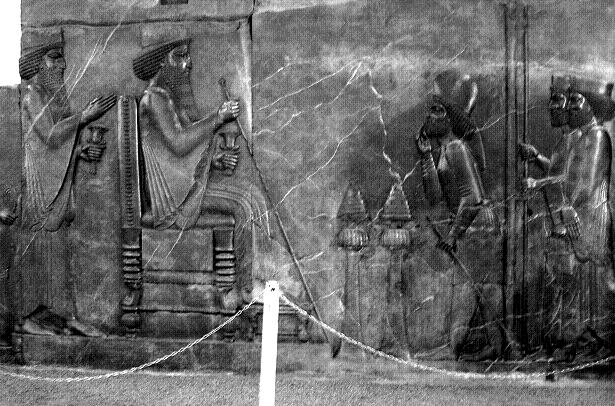
Darius was considered a great King. In his hand he holds a Lotus which symbolizes cleanliness and without Guilt. (Dirt also used for Guilt in Persian language). The statue was made of a special black material in Egypt with writing on the platform: I have wanted the Egyptians to make this statue to show how far the Persian Empire once extended. The name Darius is written after, in Persian, Babylonian and Akkadian. This is the famous Darius statue without its head. Many other statues or frescoes show him holding Lotus with two buds.

Lotuses in Hinduism symbolize prosperity,beauty fertility, eternity and eternal youth. Like Buddhism, it also means purity and divinity. A lotus is often used analogously for how people should live. One book that does this is the Bhagavad Gita at 5.10, where it states: "One who performs his duty without attachment, surrendering the results unto the Supreme Lord, is unaffected by sinful action, as the lotus leaf is untouched by water.


I had just come back from visiting my best friend in Asia, who is the founder of MeherYoga for Better Living. She is hoping to bring the philosophy of Raja Yoga to those who are already awakened to the possibility of change in them.
When I visited the Chinese village she grew up in, the second largest Chinese village in Malaysia, I was reminded of the metaphor of Lotus, arising out of mud, clearing the murky water and rising above the water to shine like the sun.
As I was writing this blog, it was close to midnight in Malaysia and I received an email from her, which I thought was more than coincidental.
I am going to bed but completed reading chapter 11 of Gita which says that ... He who performs all his duties for my (god) sake, depends on me, is devoted to me; has no attachment, and is free from malice towards all beings, reaches me.

So, I am reminded of my duty again.


So, my best friend in Asia, the one who introduced me to Raja Yoga is truly the Lotus

And as Native American Indians would say, Mitakuye Oyasin, we are all related, so to me the events of the past two weeks are related to one another, over culture, religion and distance and that people who are ready to change can experience that change.

Giverny was just an added metaphor.

As it is written,
Yoga holds that every person is capable of having these profound, life transforming experiences. It provides a clear and correct understanding of the spiritual impulse. A detailed, elaborate technology is available to hold on to it and strengthen it to an extent. The life-transforming experience is the high ground where mysticism and Yoga merge together.

I wish all my friends and other lovers, from all corners of this planet, well… The gratitude list is long today, so many people to thank but today it includes two people who live east of Tel Aviv…by hundreds of kilometers.

jeudi 19 mai 2011

The Experience of Raja Yoga: Notes from Malaysia


What is the image of Yoga in the western mind? Twisted bodies in contorted poses, clean studios where a group of people meditating or out in the open, preferably by swaying palms or poses which reminds them of something religious.
Yoga has the techniques of course, Asanas which are postures and Pranayama which are Breathing to enhance the oxygenation of your body and also parts of the body not usually oxygenated and further cleansing techniques of the Nose and Stomach.

If you are doing just this, are they valuable? What is important is the EXPERIENCE these bring to us, what does it do when we do the breathing exercises, does it bring you the peace of mind. Does the meditation bring you concentration? Do you feel more tranquil after harnessing the minds wandering nature?
When I was thinking of the above, I was very much reminded of Maurice Merleau-Ponty and his description of Phenomenology of Perception. I agree this is a thick description but not far from the ancient wisdom of Yoga.
Merleau-Ponty's existential-phenomenological epistemology and ontology can be seen as resolving the problem of Meno's paradox, and it does so by relentlessly demonstrating how both empiricism and rationalism fail to do so. Merleau-Ponty writes: "Empiricism cannot see that we need to know what we are looking for, otherwise we would not be looking for it, and intellectualism (rationalism) fails to see that we need to be ignorant of what we are looking for, or equally again we should not be searching." (Phenomenology of Perception)


"All consciousness is perceptual...The perceived world is the always presupposed foundation of all rationality, all value and all existence."

Those who have understood the philosophy of Raja Yoga would immediately understand what Merleau-Ponty was trying to say: Life is the Reality. And Raja Yoga trains a person to change that perception to become conscious of it while experiencing the reality of life.
While we think of Spirituality as more of an Eastern way of living, I feel that Spirituality is the same for all peoples, it is just that they arrive it using different philosophies.
Attachment or detachment is something you always come across when discussing Spirituality.
One very ordinary example I can give you. There are people who go to poor countries and live like poor people amidst them and try to make changes in their lives or even convert them into another religion. Whereas there are others, who have good understanding of the way of thinking of the local groups and try not to change them and also not go to the farce of living with them, knowing fully well that it would be just artificial. It is not necessarily to experience every kind of activity.
If you hear that something has happened to your inner circle of friends or family, you feel the pain, but you may not feel the pain if it happened in another country and to another group of people. But to feel the pain of all is advisable, not ignore the suffering but perhaps one learns with a higher understanding of the events, to another level of detachment. Decreasing desires is an important step towards inner happiness. Desires not only in the material sense but in other senses as well. Complete rejection of all pleasures and activities are not recommended, but that which disturbs your peace of mind has to be understood. Doing something expecting nothing in return, an altruism that I saw my own father practice, brings you pleasure and happiness.
There is a school of thought that expects you to express all your anger and fury, but it is not necessarily so. You can learn from your own experience and if you are wise you can learn from somebody’s experience. Those who are aware gain more understanding, also comes with acceptance of the other. While watching the action that give rise to anger in another person, you can control that anger and not participate in the reaction to that particular action.
Here we can also learn to accept the other person, we are not responsible for his actions but we are grateful for what they have taught us by their reactions and spared us the anger. Thus we can accept them for what they are.
We must also be careful not to try and change the other person, but learn to accept that person as they are. Change occurs when that person is ready.
One thing I had observed among the native americans, one of the many in fact, was that the practice of spirituality required no special place and very few rituals. The Medicine Man belonged to the community like every one else, being Spiritual carried no special status, they were involved in the life of the community like every one else. So it was gratifying for me to learn that at the Yoga Institute in Bombay, they teach that Yoga has to be practiced by those who are involved in Life.

featured posts

VIPASSANA MEDITATION : A SORT OF TRAVELOGUE FROM RAPA NUI TO HAVANA TO KUALA LUMPUR TO COCHIN TO MUSCAT, OMAN . THANK YOU

How Vipassana Meditation Entered My Worldview A Personal History Sometimes a teacher enters our life without either of us knowing that...